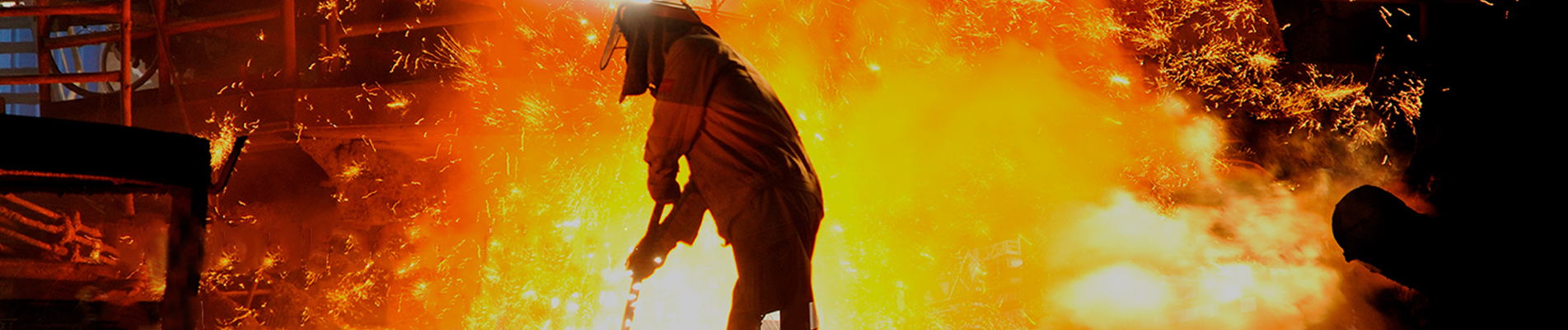
Two tadpole gaskets can have the same bulb diameter, woven fiberglass cover and mounting tail yet feel completely different when an industrial oven door closes. The difference is often hidden inside the bulb: one gasket contains an open-center knitted wire mesh core, while another uses a denser, filled mesh construction.
For a maintenance buyer, that difference can determine whether the replacement fits the existing latch system. For an OEM engineer, it affects the force needed to compress the seal, the distance the bulb can travel and how the joint behaves after repeated opening cycles. This guide compares hollow core vs solid mesh core tadpole gaskets from the standpoint of finished-gasket performance, not just the material name on a quotation.
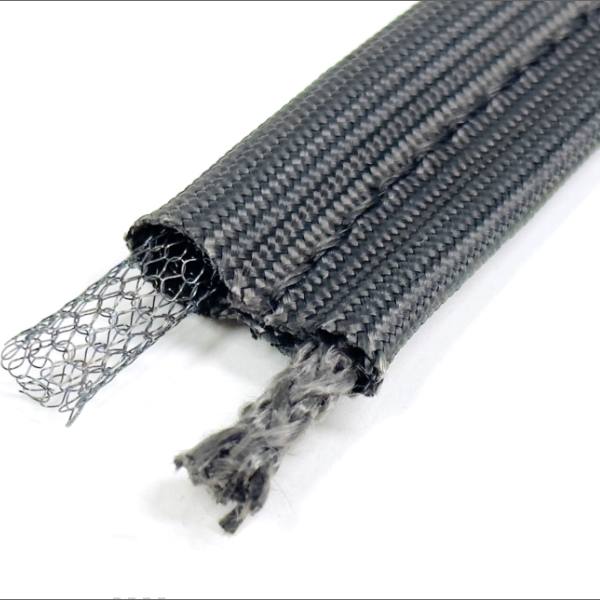
A hollow mesh core is made from a metallic knitted or formed structure with an open central region. Under a compressive load, part of the bulb can deflect into that space. The amount of travel depends on the wire size, mesh density, knit construction and the surrounding cover.
A solid mesh core is a more densely filled wire-mesh construction without the same open center. Here, solid mesh does not mean a rigid solid-metal rod. It describes how the metallic mesh fills the bulb. The wire structure remains deformable, but its force-deflection response can differ from that of a hollow core.
The metal alloy is a separate decision. Stainless steel and Inconel are core material options; hollow and filled mesh are core geometry options. A purchase order should identify both where they are known.
| Specification point | Hollow knitted mesh core | Solid or filled mesh core |
|---|---|---|
| Cross-section | Open center enclosed by a knitted or formed metal structure | Bulb interior occupied by a denser mesh structure |
| Deformation mechanism | Mesh bends and can move inward toward the open center | Mesh structure compresses and rearranges through its filled section |
| Design opportunity | Evaluate where appreciable bulb travel or limited closing force is a concern | Evaluate where a firmer support response is required |
| Variables that change performance | Wire size, knit density, hollow geometry, bulb diameter and cover tension | Wire size, packing density, construction, bulb diameter and cover tension |
| What cannot be assumed | That every hollow bulb is softer, longer lasting or more resilient | That every filled mesh bulb is too stiff or better at sealing |
The table gives design tendencies rather than guaranteed performance values. A loosely packed filled mesh may require less force than a tightly knitted hollow core at a particular compression height. The comparison becomes meaningful only after the finished profiles and test conditions are defined.
Consider an oven door with a gasket recess, retaining strip and mechanical latches. A replacement may match the original nominal bulb outside diameter but prevent the latches from reaching their intended position. If the new core requires more load at the available gap, a dimensional match has not provided a functional replacement.
Conversely, a core that deforms readily may reach the intended installed height with lower initial load but still need evaluation for recovery and long-term contact. Neither observation, by itself, proves that one core is better.
The engineering comparison should therefore keep three quantities separate:
Where force is measured on a straight sample, report both the tested sample length and the load. If the result is expressed as force per unit length, state the calculation and test setup. Otherwise, figures from two suppliers may be impossible to compare fairly.
Before deciding between a hollow core and a filled mesh core, determine the gap that the door presents to the gasket. Measure at several positions, particularly near hinges, latches and corners. Identify whether each result represents the intended closed position rather than a door that has moved farther because the old gasket was removed.
For a round bulb, its nominal diameter may be used as the free height only if that shape is confirmed. For an oval or previously compressed bulb, record height and width independently.
Nominal geometric compression can be calculated as follows:
Compression (%) = (Free bulb height - Installed bulb height) / Free bulb height x 100
For illustration, a proposed 18 mm free-height bulb installed in a 14 mm gap has about 22% nominal dimensional compression. This example does not establish an acceptable compression percentage for BSTFLEX or any other gasket. Load, recovery, temperature and leakage behavior must be checked for the actual construction.
A maintenance replacement should also include the mounting-tail width, tail thickness, overall profile width and the bulb's location relative to the retaining hardware. Incorrect tail geometry can move the bulb off its intended sealing line even when the core is suitable.
A hollow core is a logical candidate to test when a door has limited latch capacity or when excessive gasket load is preventing closure. Its open center provides a possible deformation path, but the actual working force must be measured on the proposed finished profile.
BSTFLEX offers a Fiberglass Cover Stainless Steel Hollow Core Tadpole Gasket. That page identifies the open-center core construction. It should be used as the starting product reference for this selection path.
A filled mesh core can be evaluated where a more structured response is needed under the available mounting and closing loads. A buyer should request the mesh construction and a compression-load comparison rather than relying on the word "solid" to guarantee stiffness.
BSTFLEX's Fiberglass Cover Stainless Steel Core Tadpole Gasket is a relevant metallic-core reference. Its current published product name identifies a stainless steel core but does not, by itself, establish a particular filled-mesh construction. Confirm that detail on the drawing or technical quotation before describing it as a solid mesh model.
Not every industrial door requires a wire-mesh core. Where a fiber-based construction is specified, review the Fiberglass Cover Fiberglass Core Tadpole Gasket. Fiber cores have their own compression characteristics and should be tested against the same door gap and operating requirements, rather than treated as a universal soft-core benchmark.
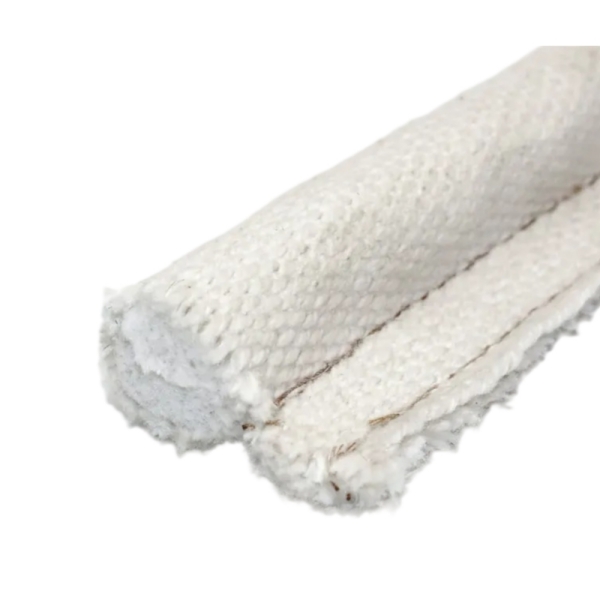
A meaningful hollow-versus-solid mesh comparison needs more than one photograph of each cut end. For OEM qualification, agree a small, controlled test plan before sample production. The following sequence helps keep the results comparable.
Do not transfer a competitor's published recovery percentage into a BSTFLEX specification. Compression-set and recovery results depend on the finished construction and test method. A quotation should state measured values only when they have been established for that specific gasket.
| Record | Minimum useful information |
|---|---|
| Sample identification | Cover, core alloy, core geometry, bulb size, tail dimensions and sample length |
| Free profile dimensions | Height, width and measurement method before testing |
| Test fixture | Compression surfaces, loading direction and mounting arrangement |
| Load-versus-height readings | Measured force at each agreed compressed height |
| Recovery | Recovered height, waiting interval and residual deformation after unloading |
| Repeated cycling | Cycle count, test sequence and observable changes |
| Thermal exposure | Temperature at the gasket, exposure duration and conditioning procedure |
| Acceptance criteria | Agreed closing-load limit, contact requirement, dimensional tolerance and applicable equipment test |
A simple spreadsheet of the measurements can be more useful to an engineering buyer than a single statement that a core is "highly compressible." It allows the buyer to judge whether the gasket reaches the specified height within the available latch force.
The operating limit of a tadpole gasket depends on the entire assembly: cover fabric, coating, core alloy, stitching and the exposure at the sealing line. Hollow mesh does not inherently mean a lower or higher temperature rating than filled mesh of the same alloy and construction family.
Similarly, changing from stainless steel to an Inconel-based core is a separate engineering decision from changing between hollow and filled geometry. The alloy decision should consider the actual core temperature, atmosphere, oxidation and any relevant chemical exposure.
Avoid using the oven's nominal chamber setting as the only temperature input. The gasket may experience a different temperature because of its position relative to the door frame, refractory lining, contact surfaces and hot-gas path.
Check the replacement free height, installed gap, tail position and actual load at closure. A different core construction may be contributing to the problem, but overlarge bulb dimensions or misaligned retaining hardware can produce similar symptoms. Do not simply force the latch closed.
Inspect for residual deformation, movement under the retaining bar, damaged corners and changes in door alignment. A recovery test can help compare candidate cores, but contact loss cannot be diagnosed from the core material alone.
This indicates that exposed fabric and the equipment contact path deserve attention. Internal mesh reinforcement does not automatically prevent abrasion of the outer cover. Review sharp edges, sliding motion and the need for a different textile or separately specified external protective construction.
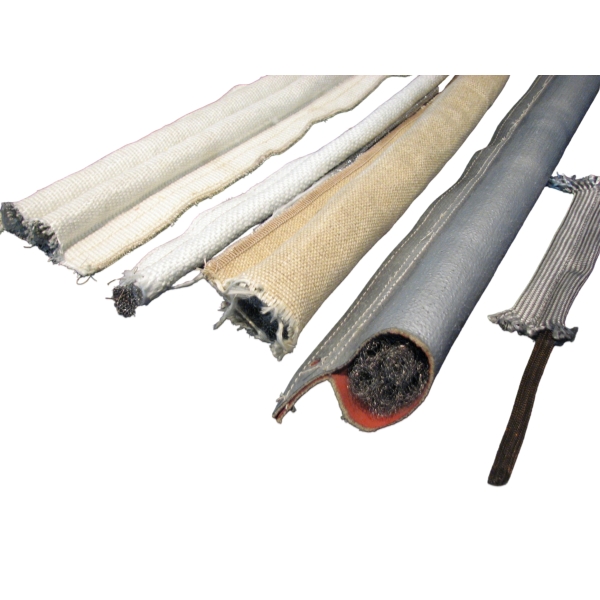
For industrial oven doors, the available latch load and variation around the door perimeter are often central to the decision. Compare candidates at the equipment's installed gap instead of ordering by catalog bulb diameter alone.
For furnace access panels, evaluate thermal exposure in addition to load and recovery. A suitable core cannot compensate for an unsuitable cover or stitching material.
For duct covers and dampers, consider pressure differential, vibration, opening frequency and allowable leakage. A textile tadpole gasket should not be assumed gas-tight or pressure-rated without validation of the complete joint.
For large access doors with uneven gaps, map the minimum and maximum closed gaps. An open-center core may be worth testing, but both the tightest and widest regions must remain within the selected gasket's validated working range.
For prototype or repeat OEM supply, send a dimensioned drawing and an operating-condition sheet. Where the existing core is unknown, describe it as unconfirmed and provide a cut-end photograph or representative sample for review.
| RFQ field | What to provide |
|---|---|
| Application | Oven door, furnace panel, duct cover, damper or another specific joint |
| Cover | Fiberglass, silica, ceramic, treated textile or other required cover |
| Core alloy | Stainless steel, specified high-temperature alloy or unknown |
| Core geometry | Hollow knitted mesh, filled mesh or unknown; include cut-section evidence |
| Bulb dimensions | Free height and width, or diameter where the bulb is round |
| Tail and profile | Tail width, thickness, overall width and mounting location |
| Installed gap | Minimum, maximum and nominal closed height at the bulb contact line |
| Closing load | Available latch force or required force-deflection criterion, if known |
| Service | Continuous and peak temperature, exposure duration, vibration and cycle frequency |
| Order format | Cut lengths, continuous material or finished frame with corner details |
| Quantity | Samples and anticipated production volume |
| Evidence | Original drawing, sample, photos or existing specification |
For drawing-based development and repeat supply, see BSTFLEX's Custom Tadpole Gasket Manufacturer page. For the wider cover-and-core range, visit Tadpole Gasket and Tadpole Seal Products.
No. In this product category, it refers to a denser or filled metallic mesh construction. A knitted wire mesh core is not the same as a rigid metal bar.
No universal rule applies. Hollow geometry can provide an inward deformation path, but wire diameter, knit density, finished bulb size and cover tension determine the actual load-deflection response.
No. Stainless steel identifies the alloy family, while hollow or filled mesh identifies the structure. Confirm both on the purchase specification.
Not necessarily. Service life also depends on operating temperature, compression, cycling, cover abrasion, chemical exposure, mounting geometry and how the gasket is used.
It may be possible after engineering review, but the substitution changes the core construction. Validate the installed gap, closing load, recovery and complete equipment seal before approving the replacement.
Provide the gasket cross-section, available door gap, operating conditions, required length and quantity. If the application has a defined closing-force or leakage requirement, include that requirement rather than asking only for a nominal diameter.
The practical difference between a hollow mesh core and a filled mesh core is not an abstract ranking of softness. It is how each finished gasket responds to the equipment's actual load, gap and operating cycle. Use the core construction to form a shortlist, then qualify the gasket against the required installed height and service conditions.
BSTFLEX can review fiberglass-covered hollow stainless steel core and fiberglass-covered stainless steel core constructions as the starting points for an OEM or replacement proposal. Identify a solid or filled mesh variant explicitly before treating it as an approved model.

 English
 français
 Deutsch
 русский
 italiano
 español
 português
 Nederlands
 العربية
 日本語
 한국의
 Türkçe
 Polski
 Tiếng Việt
 Indonesia